This blog was birthed from a school assignment. Yep. That's right. You've been reading my homework!
And since the course is coming to a close, I feel I should let you all know what the program has been about and maybe give a little shout-out to the post-secondary institution that spawned all this blogging magic.
I'm currently enrolled in the Vancouver Community College (VCC) School of Instructor Education. Specifically, I'm working on my BC Provincial Instructors Diploma. Now, don't let the name fool you - either the "BC" part or the "Diploma" tag. This program is offered and carries relevance beyond beautiful British Columbia's borders, and "Diploma" hardly does justice to the relevance, rigor, and practical nature of the program. Here is where you learn all about adult education, from its foundations to its effective practice.
I've been impressed by the diversity of classmates - people from the trades, people who are in corporate training, teachers who are already teaching but whose institutions insist they go through the certification, and all kinds of professionals looking for a career change. The range of participants and the longevity of the program is evidence (to me, anyway) of the good practices and reflective methods the program fosters.
If you're curious what piques the curiosity of students like us, I'd suggest checking out the VCC School of Instructor Education Facebook page. There are piles of resources for adult educators relating to all sorts of aspects of teaching and learning, from student engagement techniques to assessment strategies and tips for web-based tools that translate well to the classroom. Lots of good stuff there!
Or if you're curious about the program itself, the participant's handbook is a great resource.
Now, this really wasn't meant to be such a shameless plug, but what can one do but stop typing?
And on that note...
Thursday, March 7, 2013

Tuesday, March 5, 2013
This Week in Science: Alice the Camel had a Parka?
Well, the Twittersphere was abuzz today with articles about fossil evidence in the high arctic, suggesting CAMELS once roamed Ellesmere Island!
CBC has two articles on the find: here and here.
And there's a photo slide show of the discovery here.
But the best resources (including a video!) are here, from the Canadian Museum of Nature, whose team made the discovery.
According to the news feeds, the fossils are from 3.5 million years ago, when Ellesmere was quite a bit warmer. Also, the camels were much larger than today's camels. But they're not the only camels found in the north: camels were know in the Yukon region as well.
Canadian Museum of Nature Educational Resources
For the educators on the other side of the screen, the Canadian Museum of Nature's website (http://nature.ca) has a great set of resources for the classroom, including teaching kits, classroom activities, and interactive learning modules online. This link is a great starting point.
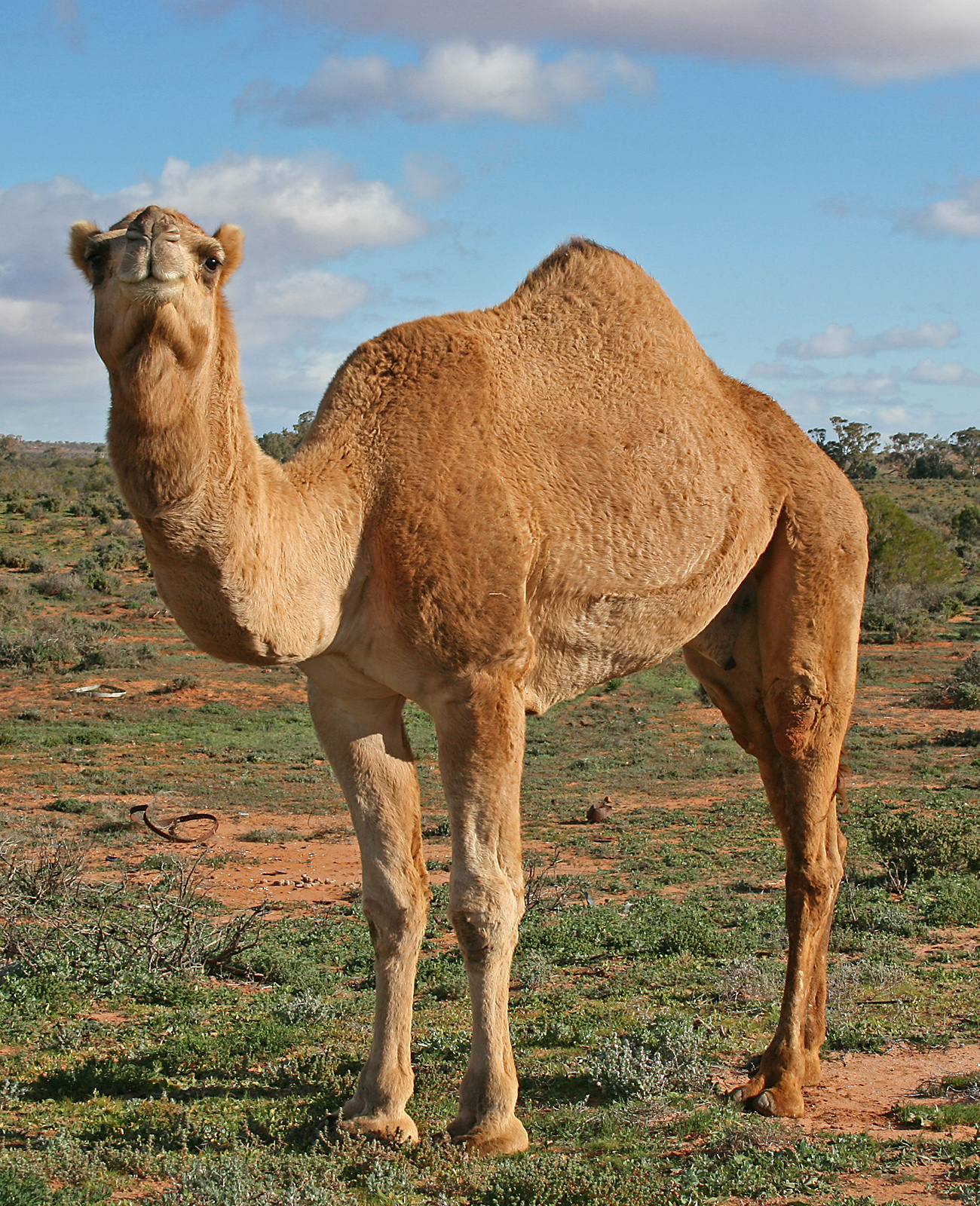 |
| Free creative commons image from Wikipedia |
CBC has two articles on the find: here and here.
And there's a photo slide show of the discovery here.
But the best resources (including a video!) are here, from the Canadian Museum of Nature, whose team made the discovery.
According to the news feeds, the fossils are from 3.5 million years ago, when Ellesmere was quite a bit warmer. Also, the camels were much larger than today's camels. But they're not the only camels found in the north: camels were know in the Yukon region as well.
Canadian Museum of Nature Educational Resources
For the educators on the other side of the screen, the Canadian Museum of Nature's website (http://nature.ca) has a great set of resources for the classroom, including teaching kits, classroom activities, and interactive learning modules online. This link is a great starting point.
Thursday, February 28, 2013
Twitter me this
I've been trying for a few weeks to get the Twitter gadget to work on my blog, but can't seem to make it work. Thus, I'll go for the less glamorous option and link to my Twitter feed from a regular ol' post.

Poor returns on educational investments?
This article from the Globe and Mail is over a year old, but the situation hasn't changed much in Canada: students are getting deep into debt for their education and having trouble finding related work and shoulder a substantial level of debt as a result.
CBC even has a documentary on the trend, called Generation Jobless, which you can watch here.
Even tonight on the Lang and O'Leary exchange, they discussed the federal government's thoughts on revamping student loan repayment criteria (you can see the link here; the education segment runs from roughly 27:00 to 33:00). They talk about changing the repayment timelines, the interest rates, making loans dependent on grades, and more. Kevin O'Leary provides a particularly *ahem* interesting point of view, as usual. Leave no (rich) man left behind, basically.
It seems student loans were on everyone's minds today, east to west: the BC government issued a press release concerning changes to the BC student loan system to better accommodate students.
Wednesday, February 27, 2013
Online Research and Critical Thinking Skills
Microsoft has a great page, full of resources for educators who want their students to do research online while using (and developing) their critical thinking skills.
There are lesson plans, handouts, worksheets and demos on topics like searching, plagiarism, validity and reliability, citing web sources and civil discourse. There's also a great guide available for download called Developing Critical Thinking Through Web Research Skills.
Consider using this in your class!
Tuesday, February 26, 2013
Boat or Bandwagon?
Tony Bates’ blog,
which is a class resource for PIDP3240, has a posting on forecasts for online education. In it is a chart that is meant to speak
to the development of massive open online courses (MOOCs), and the course Tony
predicts they’ll run over the next few years.
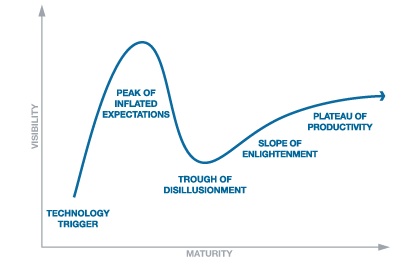 |
The technology hype cycle: from www.tonybates.ca
|
I can’t help but see myself in this graph. Perhaps I’ve skipped the “peak of inflated expectations” altogether, and am starting instead in the trough of disillusionment about using social media and piles of technology in the classroom. I clearly need some enlightenment to get me to a more productive plane.
I suppose I like my classes the way they are, in many
respects, and would introduce only the tools I deem most useful or applicable
(using course objectives as a reference point), rather than the most popular or
trendy. If a web tool or social media platform can be
used to foster curiosity, reflection, and/or peer/self-directed learning about
the natural world, I am game. If these
ends can be equally met in the classroom or a field outing, I will chose the unplugged
version most of the time.
Why? Because I believe that first-hand
observation and experience are two of the greatest learning tools when it comes
to science and biology. Let the students type
and be screen-bound in their other classes.
Let them see, touch, smell, experiment, explore, and create in mine!
I feel that I am tremendously fortunate to teach sciences,
because it lends itself so well to experiential learning.
But like I said before: maybe Tony's got it right. I just need a little enlightenment to find a way to reconcile my teaching philosophy and strategies to this trend in education delivery. I'm hoping to find a happy, productive middle-ground on this one.
"If you see a bandwagon, it's too late." - James Goldsmith
Sunday, February 24, 2013
This week in science: the tooth, forsooth!
Did you know that the narwhal tusk is actually a modified tooth?
To tie into my earlier post on traditional knowledge (TK), here is a great instance of scientists working with local TK holders to conduct their study on narwhals in the eastern Arctic. This article isn't quite from the last week, but "This fortnight in science" just doesn't have the same right to it.
Enjoy the article, including a slideshow of the research team in action!
 |
| Free image from Wikipedia. |
To tie into my earlier post on traditional knowledge (TK), here is a great instance of scientists working with local TK holders to conduct their study on narwhals in the eastern Arctic. This article isn't quite from the last week, but "This fortnight in science" just doesn't have the same right to it.
Enjoy the article, including a slideshow of the research team in action!
Traditional Knowledge in the Classroom
Western Scientific knowledge.
Traditional (ecological) knowledge.
Some believe that never the twain shall (or should) meet.
As a science teacher I couldn't disagree more.
Adult educators talk about how to motivate students, how to foster a positive, inclusive classroom atmosphere. I believe that the use of traditional knowledge (TK), story telling, even sharing experiences on the species, habitats, or concepts being studied can help with this.
Also, scientific and traditional knowledge, though different (quantitative vs. qualitative, written vs oral transmission, short term vs long term, etc.,), both have their place in learning. The challenge is not (surprisingly) incorporating TK into curriculum, or even developing whole units of learning using TK, but the dilemma that comes with authentic assessment: a course that is for credit means marks, which means formal assessment. How does one reconcile that with the course objectives, which could be cultural or affective in nature? In a region where cultural expertise is measured in handiwork, in depth of cultural knowledge and years of experience, how does one measure and assign value to learning? The validity issues are many.
Dilemma aside, here is a UBC blog post with resources on ways to incorporate TK in the classroom, including the use of technology to preserve it. The Handbook for Culturally Responsive Science Curriculum that the author links to is something I'd like to explore more, since it raises the issue of assessment strategies, as well as how to host elders in the classroom.

Traditional (ecological) knowledge.
Some believe that never the twain shall (or should) meet.
As a science teacher I couldn't disagree more.
Adult educators talk about how to motivate students, how to foster a positive, inclusive classroom atmosphere. I believe that the use of traditional knowledge (TK), story telling, even sharing experiences on the species, habitats, or concepts being studied can help with this.
Also, scientific and traditional knowledge, though different (quantitative vs. qualitative, written vs oral transmission, short term vs long term, etc.,), both have their place in learning. The challenge is not (surprisingly) incorporating TK into curriculum, or even developing whole units of learning using TK, but the dilemma that comes with authentic assessment: a course that is for credit means marks, which means formal assessment. How does one reconcile that with the course objectives, which could be cultural or affective in nature? In a region where cultural expertise is measured in handiwork, in depth of cultural knowledge and years of experience, how does one measure and assign value to learning? The validity issues are many.

Friday, February 22, 2013
This resource for science instructors is the bee's knees!
Well, thank you, Federal Government! What a lovely collection of resources for science teachers in Canada!
http://www.science.gc.ca/Educational_Resources-WSBB254133-1_En.htm
I shared this with a few classmates in the PIDP 3240 forums, and reminded them that while this is geared for K-12, the resources can still be useful for introducing or reviewing key concepts. Also, I've never had a class of adults who were opposed to playing games or even getting into a learning activity that required scissors, glue, and construction paper. So check it out!
My favourite from this site so far is a link to Bees: a Honey of an Idea - which is a beautiful Agriculture Canada/Virtual Museum website for learning about pollination and the importance of bees to agriculture. The layout is like a book, and the information is clear and concise. A great resource, to be sure.
Though I am a little biased...
And to take it home, here is a sample of science humour:

http://www.science.gc.ca/Educational_Resources-WSBB254133-1_En.htm
 |
| Look at all those categories! And great links in the side bar! |
I shared this with a few classmates in the PIDP 3240 forums, and reminded them that while this is geared for K-12, the resources can still be useful for introducing or reviewing key concepts. Also, I've never had a class of adults who were opposed to playing games or even getting into a learning activity that required scissors, glue, and construction paper. So check it out!
My favourite from this site so far is a link to Bees: a Honey of an Idea - which is a beautiful Agriculture Canada/Virtual Museum website for learning about pollination and the importance of bees to agriculture. The layout is like a book, and the information is clear and concise. A great resource, to be sure.
Though I am a little biased...
 |
Beekeeping is a dream of mine; visiting family in Germany, I found out one of my uncles raises bees. I was very happy to learn all I could from him, and to see first hand how the colonies operate. Because there'd be no botany if there weren't pollinators!
|

Podcast: Building a Better Classroom
I encourage you all to take some time to listen to this podcast: Building a Better Classroom, from NPR's TED radio hour.

The speakers are fantastic:
While the podcast covers all levels of education (elementary through university), I believe the principles are transferable to any classroom, with a bit of creativity and elbow grease. It also demonstrates how constructive, group learning and self-directed learning can take place at any age or maturity level. Don't underestimate your students - only make room for them and see what they can do!
So turn off the TV. Get out for a walk or load this podcast up on your commute home. It's really worth a listen.
One more time, here's the link: NPR TED Radio Hour - Building a Better Classroom.

The speakers are fantastic:
- Sir Ken Robinson, famous for his "Schools kill creativity" TED talk,
- Salman Khan, creator of the Khan Academy, and
- John Hunter, who gets his fourth graders to solve world problems and wrote a book about it called World Peace and other 4th Grade Achievements (there's a documentary, too!).
While the podcast covers all levels of education (elementary through university), I believe the principles are transferable to any classroom, with a bit of creativity and elbow grease. It also demonstrates how constructive, group learning and self-directed learning can take place at any age or maturity level. Don't underestimate your students - only make room for them and see what they can do!
So turn off the TV. Get out for a walk or load this podcast up on your commute home. It's really worth a listen.
One more time, here's the link: NPR TED Radio Hour - Building a Better Classroom.
Tuesday, February 19, 2013
This Week In Science: Strings Attached
This week, CBC came out with an interesting story:
Canadian federal research deal 'potentially muzzles' U.S. scientists
(a more detailed radio interview is also available at the link)
While the current government has been rather overt with its reformations and funding cuts in the sciences, this story brings to light a less obvious but important change: the wording in contracts and contribution agreements surrounding the use and distribution of research results.
I was tempted to keep personal opinion out of this post, but I think this article raises the type of questions that make science relevant to our every day lives: it touches on policy, the strings attached to research funding, the impact of current events and politics on the studies that are approved or funded, and the communication of (hopefully objective) results.
Discussion fodder abounds. Learning opportunities here? You betchya.
Canada always seemed a democracy to me. This sort of thing is very unsettling to me, and makes me question what we're really about as a nation, and where we might be headed.
It seems, unfortunately, that these gag orders have been around for a while (see this 2010 article: Federal scientists go public in face of restrictive media rules ) and scientists have created their own website (publicscience.ca) to make research and research issues more available to the public, and to communicate why public science matters.
Here is their website banner. Go have a visit, if you like.

PART DEUX
Should Canada take lessons from Finland's approach to education?
(video and radio clips available at the link to supplement the article)
Well, if not the Finnish approach, we need to try SOMETHING different in North America. Because continuing down the same path will lead us to where we've already been, and the old ways just aren't cutting it.
And that, I suppose, is the trick to successful teaching: don't settle into a routine. Stay current, both in your field of expertise and in the tools that you use to deliver a course. Flip the classroom if you want. Start a blog. Get students teaching students. Make the learning experience meaningful and valuable. Don't be scared of where students might take a lesson or discussion: facilitate self-directed learning and discovery.
If you're a science teacher, do more field trips. Set aside the lesson plan for an afternoon, and ask students to simply observe, to look for patterns, for research questions, for new information in a familiar habitat or setting. Let THEM discover and uncover - hang up your hat as content expert and see what they can learn or observe for themselves. Foster curiosity and ownership. Trust that they are capable of brilliance, and facilitate their analytical skills.
Ok. The soapbox has been put away. Now back to regular scheduled programming.
Canadian federal research deal 'potentially muzzles' U.S. scientists
(a more detailed radio interview is also available at the link)
While the current government has been rather overt with its reformations and funding cuts in the sciences, this story brings to light a less obvious but important change: the wording in contracts and contribution agreements surrounding the use and distribution of research results.
I was tempted to keep personal opinion out of this post, but I think this article raises the type of questions that make science relevant to our every day lives: it touches on policy, the strings attached to research funding, the impact of current events and politics on the studies that are approved or funded, and the communication of (hopefully objective) results.
Discussion fodder abounds. Learning opportunities here? You betchya.
Canada always seemed a democracy to me. This sort of thing is very unsettling to me, and makes me question what we're really about as a nation, and where we might be headed.
It seems, unfortunately, that these gag orders have been around for a while (see this 2010 article: Federal scientists go public in face of restrictive media rules ) and scientists have created their own website (publicscience.ca) to make research and research issues more available to the public, and to communicate why public science matters.
Here is their website banner. Go have a visit, if you like.

PART DEUX
In other (less sciencey) news, the Finns seem to have us all beat, education wise:Should Canada take lessons from Finland's approach to education?
(video and radio clips available at the link to supplement the article)
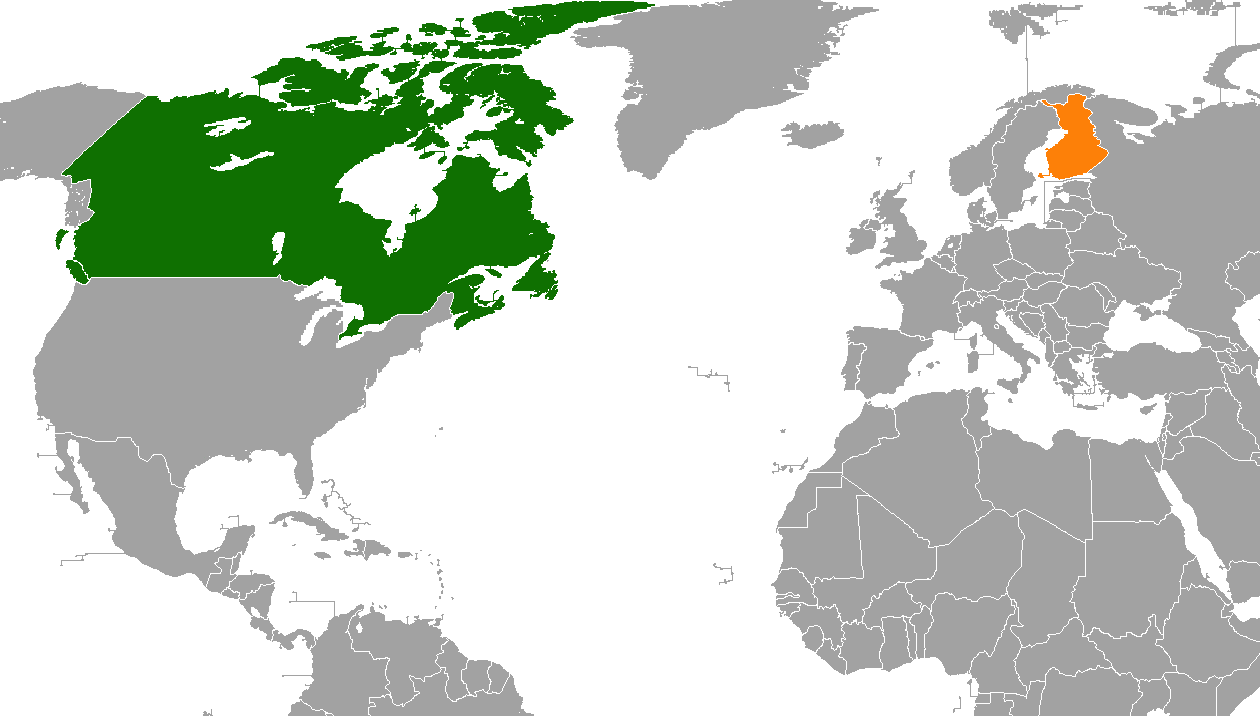 |
| Canada and Finland |
Well, if not the Finnish approach, we need to try SOMETHING different in North America. Because continuing down the same path will lead us to where we've already been, and the old ways just aren't cutting it.
 |
| Good ol' Albert. |
And that, I suppose, is the trick to successful teaching: don't settle into a routine. Stay current, both in your field of expertise and in the tools that you use to deliver a course. Flip the classroom if you want. Start a blog. Get students teaching students. Make the learning experience meaningful and valuable. Don't be scared of where students might take a lesson or discussion: facilitate self-directed learning and discovery.
If you're a science teacher, do more field trips. Set aside the lesson plan for an afternoon, and ask students to simply observe, to look for patterns, for research questions, for new information in a familiar habitat or setting. Let THEM discover and uncover - hang up your hat as content expert and see what they can learn or observe for themselves. Foster curiosity and ownership. Trust that they are capable of brilliance, and facilitate their analytical skills.
Ok. The soapbox has been put away. Now back to regular scheduled programming.
Twitter with a twist
Here's tongue-in-cheek sound clip from CBC on using Twitter for teaching. Enjoy!
THIS IS THAT - Teacher Educates Only Using Twitter
(only 4 minutes long)
They mention Finland in the clip. I may post on that a little more this week.
THIS IS THAT - Teacher Educates Only Using Twitter
(only 4 minutes long)
They mention Finland in the clip. I may post on that a little more this week.
Sunday, February 3, 2013
Earth Viewer: great new app for the classroom!
Howard Hughes Medical Institution has just released a new app: Earth Viewer (click the link for the news story).
Sounds like Google Earth? Well, not quite. While Google Earth gives us a view of the planet as it looks today (or within the last few years of available satellite imagery), Earth Viewer lets us explore the planet over the last 4.5 billion years.
This page offers a video of the app, as well as ways to use this app in the classroom: http://www.hhmi.org/biointeractive/earthviewer/
Here are some screenshots, when I was playing around with it earlier this week:

195 million years ago, days were only 23 hours long,
and the Americas were nestled right up against Europe and Africa.
and the Americas were nestled right up against Europe and Africa.
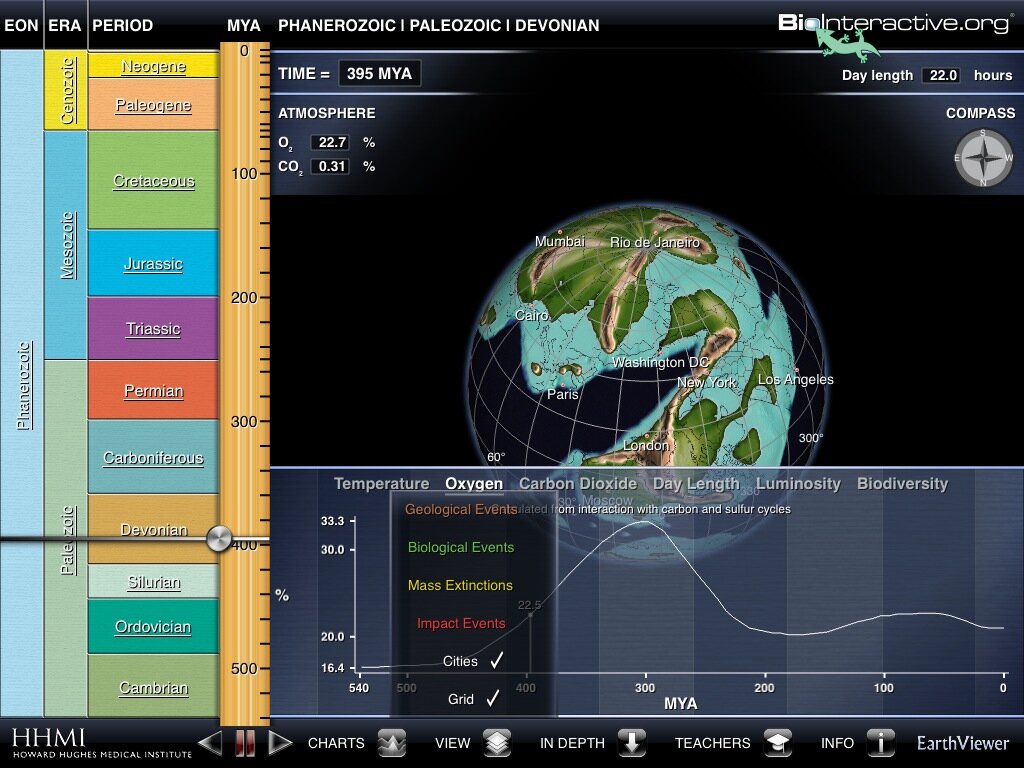
395 million years ago, oxygen levels were on the rise, and Rio de Janiero
was situated at the South Pole! Some of the charts and menu options are also shown here.
Best of all, the app is FREE!
So take note, teachers and students. This is a great resource for the classroom, whether in person or online.
Monday, January 28, 2013
Krulwich really IS a wonder
To kick things off, I want to share one of my FAVOURITE science blogs: Krulwich Wonders.
It's ok. I can wait.
Go on - check it out.
Use up that coffee break.
Browse away through that conference call.
Get lost in his posts when you should be writing that essay.
If you need a way to kill time on the internet (because what is the internet, if not a spectacular venue for procrastination?), Krulwich will have you learning things unwittingly. And that, my friends, is time well wasted!
But if you haven't clicked on the link, or if I haven't convinced you why you ought to, allow me to offer my humble (though enthusiastic) opinion on the matter of Mr. Krulwich. Let me be explicit, even, as to why I like his blog, and why I really do believe it's time well spent/wasted over there:
- He brings the fascinating to the forefront. Even in his more philosophical posts, my interest is always piqued.
- He spans all scientific subject matter, unlike some blogs or radiohosts, who naturally favour their personal interests (e.g. Mr. Bob McDonald, the host of CBC radio's Quirks and Quarks, whose bias towards the interplanetary and cosmic is blatant, and evidenced by the stories he highlights). DISCLAIMER: I do not claim to be better than this behaviour. I'm just expressing my sincere appreciation of Mr. K's ability to give everyone some field time.
- His posts are relevant. You're in the middle of flu season? Here's a post. Current events are fuel for his entries, but don't overwhelm.
- To carry on the last point, Krulwich has achieved a great balance between levity and stick-to-your-ribs food-for-thought. He even waxes philosophical every once in a while.
- He makes things relatable. Big scary ideas. Even big, scary, sacred, scientific icons. I love his post about Charles Darwin And The Terrible, Horrible, No Good, Very Bad Day. Suddenly, Darwin becomes a little more approachable. A little more grumpy and self deprecating. But definitely someone I could talk to.
This pic is right off of Mr. K's post about the day poor ol' Charlie should've just stayed in bed. .
So there you have it. All the reason why I like Krulwich Wonders. You'll see as I post more and more, why I value the things about it that I do. If my blog starts looking a little like his, I couldn't be more proud.
Bottom line: go and enjoy his blog. I sure do!
Well, here goes nothing!
Over the next few months I'll be using this space to ask questions. Of myself, of my readers, and of my students. I want to carry part of my classroom into this quiet little mini-world that is my blog - a mere subatomic particle in the wild, expanding universe of electronic experience that is the Internet! - the part that marries big picture ideas with local examples, course content with current events.
So give me some rein - let me guide you through my thoughts, my musings, as I look for pieces, patterns, and process in my surroundings, and then, only if you like, teach you something new along the way.
I teach sciences here in Inuvik, and my background is in environmental biology and ecology. But don't let that scare you away. I prefer analogies and parables over jargon and nomenclature (whoops - was that jargon? haha). Current events, local research, and everyday living offers ample fodder for illustrating concepts, so fear not. Just sit back and stay tuned.
Subscribe to:
Posts (Atom)